
If you’ve spent any time casting lines around Bear’s Den Lodge, you already know the French River is a world-class fishery teeming with legendary predators. Most anglers come scanning the weed lines for the aggressive strike of a monster Northern Pike. But there’s another toothy giant cruising these same waters — one that was swimming here long before the pike ever evolved.
We’re talking about the Longnose Gar (Lepisosteus osseus).
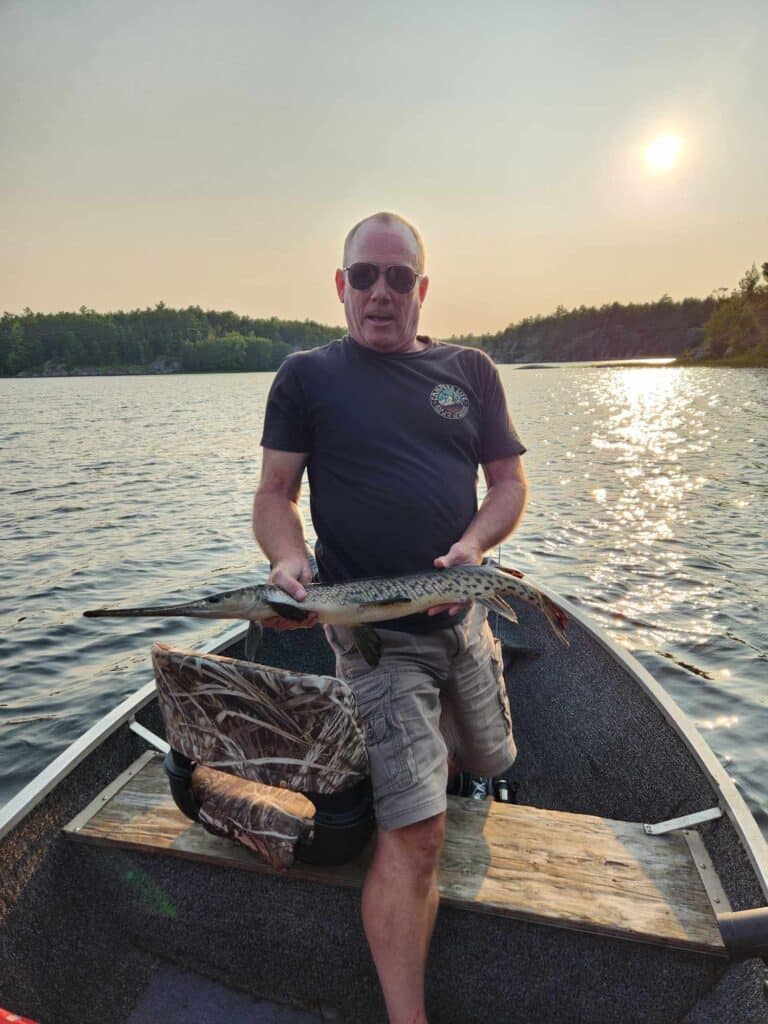
As we explored in our look at the 3 Important Ancient Fish of Ontario, the Longnose Gar is a genuine living fossil, with a lineage stretching back over 100 million years that at one time shared the planet with the Tyrannosaurus rex. And in our Northern Pike vs. Longnose Gar breakdown, we noted that while both fish sport torpedo-shaped bodies and a mouthful of teeth, they couldn’t be more different under the surface. Pike are modern, cold-water sight predators covered in smooth cycloid scales. Gar are armoured relics, shielded in interlocking, enamel-hard ganoid scales, built around a snout up to twenty times longer than it is wide.
Nowhere is that divide more dramatic than in how the two species bring the next generation into the French River delta. Pike quietly scatter their eggs in the frigid waters of April. The Longnose Gar waits for the warmth of late spring to throw an absolute underwater party! This is perhaps one of the wildest, least-witnessed spectacles in Ontario’s freshwater world.
What Temperature Triggers Gar Spawning?
Unlike pike, which get moving the moment the ice barely lets go, Longnose Gar are warm-water enthusiasts. They spend early spring moving through the river system at a slower pace, but as water temperatures climb toward that magic 20°C (68°F) threshold in late May or June, everything changes.
The shallow, weedy bays, rocky shoals, and slow-moving backwaters around the French River delta suddenly become staging grounds for one of the most intense reproductive events in the freshwater world: the spawning aggregation.
The Nuptial Dance: A Chaotic Spectacle
Gar don’t spawn solo. When the temperature is right, a single large female moves into the shallows and immediately draws a crowd — it’s not uncommon for one female to be courted by anywhere from two to eight eager, smaller males at once.
What follows is a literal nuptial dance. The males flank the female, circling in tight, synchronised formation. The water breaks with sudden, explosive splashing and convulsive body movements as the males jockey for position. It isn’t just for show — the physical contact and vibration are what trigger the female to release her eggs, similar to that of a Muskie spawn. The male Gars then fertilize externally in a cloud of disturbed river silt.
Longnose Gar typically spawn in the French River from late May through June, once shallow water hits about 20°C (68°F) — weeks after Northern Pike finish their own spawn.
Why Gar Eggs are Green?
If you look closely at a freshly laid bed of gar eggs, you’ll notice something striking: they’re a vivid, almost neon green. A single female can lay tens of thousands of them in one season. Ontario fishing guide Rob Jackson — who once held the provincial record for the biggest gar ever landed — puts it simply: a female gar lays roughly 3,000 eggs for every pound of her body weight. Scale that up, and a healthy 15-pound female is capable of dropping upwards of 45,000 eggs in a single spawning season.
That number holds up against the science. A classic Missouri study of the species (Netsch & Witt, 1962, Transactions of the American Fisheries Society) documented females laying anywhere from roughly 4,300 to nearly 60,000 eggs, averaging close to 28,000 — right in the range Jackson’s rule of thumb predicts for a mid-sized fish. Some coastal populations have been recorded depositing up to 77,000 eggs in a season. However you slice it, a single French River female can seed a bay with tens of thousands of eggs in one go.
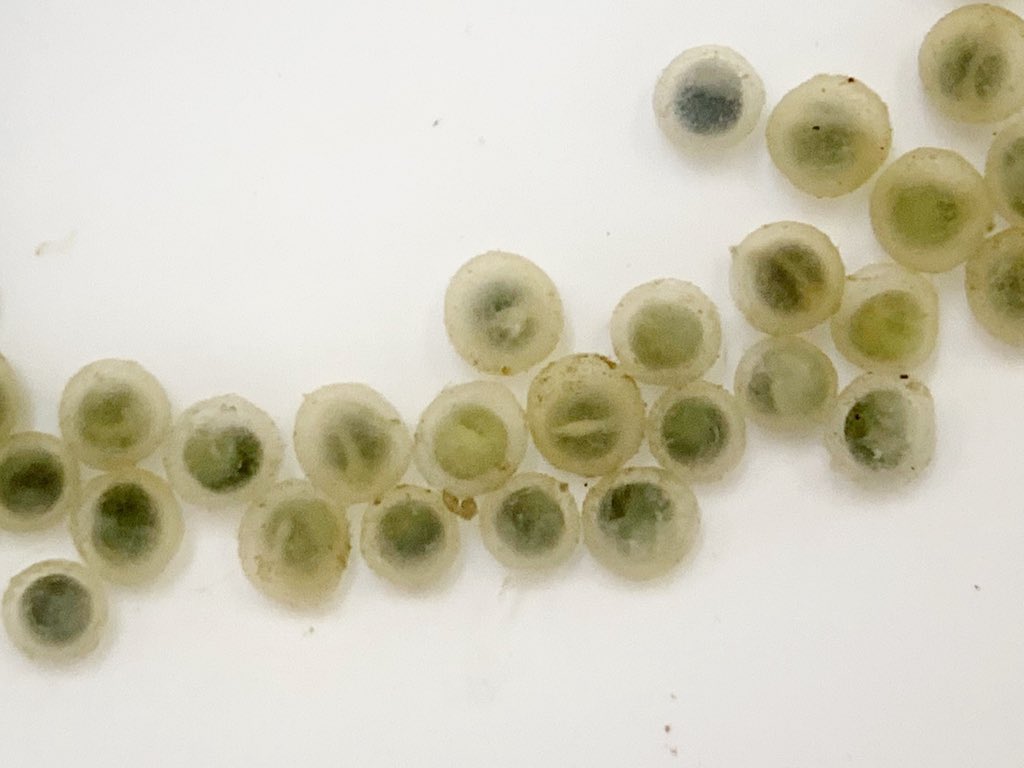
That colour is a warning label. Gar eggs contain ichthyotoxin, a protein-based toxin that makes them genuinely dangerous to warm-blooded animals. Documented medical case reports describe humans who accidentally ate gar eggs developing nausea, vomiting, and a dangerous drop in blood pressure within about an hour — and there’s no specific antidote, only supportive treatment. Researchers believe the toxin evolved specifically to deter egg-eating predators like crayfish, which often swarm the same shallow, sparsely vegetated shoals gar prefer for spawning. Aquatic insects and other fish seem largely unbothered, but any small mammal, bird, or curious dog that goes after a bed of gar eggs is playing with real fire.
As an added layer of defense, the eggs are also coated in a sticky, adhesive substance. The instant they hit the water, they glue themselves firmly to submerged vegetation and rock, immune to being swept away by the French River’s current.
Zero Parental Care, Maximum Speed: From Snout-Bridges to 22 Inches
Once the eggs are cast, the parents offer nothing in the way of childcare — an opportunistic adult gar won’t hesitate to eat its own young given the chance. Left entirely to fend for themselves, the toxic green eggs hatch fast, usually within 3 to 9 days, depending on water warmth.
The newly hatched larvae are strange, wonderful little things. They’re born with a temporary “adhesive bridge” on top of the snout — a biological suction cup they use to anchor themselves vertically to plants and stable structures, staying mostly motionless for 10 to 11 days while they absorb their yolk sac.
Once they detach, the growth is explosive. Fueled by the same nutrient-extracting spiral valve digestive tract we covered in our ancient fish piece, a single fingerling can pack on up to 22 inches of length in its very first season. It’s a survival strategy built for speed: get out of “easy meal” size before the resident bass and pike take notice.
Why This Matters: The Gar’s Role Beyond the Spawn
It’s tempting to treat the spawning aggregation as a one-off curiosity, but it’s actually a window into something bigger. A 2023 acoustic telemetry study out of western Lake Ontario (Croft-White et al., published in Environmental Biology of Fishes) upended the old assumption that Longnose Gar were homebodies that rarely strayed from one spot. Tagged fish showed three distinct patterns:
- Some Gar stayed resident near their tagging site.
- Others migrated significant distances.
- The last group switched between the previous two behaviours from year to year, with some individuals covering over 180 km.
Regardless, activity peaked in the summer and fall and before dropping off in winter.
That matters for a river system like the French: it tells us Gar spawning aggregations aren’t isolated pockets of fish that never leave their bay. They’re part of a much more dynamic, connected population moving through the wider watershed. Thus, this is exactly the kind of behaviour that makes a healthy, mostly undammed river system like this one so valuable to the species.
An Angler’s Guide to Witnessing (and Respecting) the Spawn
Longnose Gar are rarely targeted on purpose in Ontario, but late spring and early summer give you a rare shot at seeing one of the province’s oldest fish species doing something genuinely primordial. A few things worth knowing if you want to catch it firsthand around the French River delta:
- Time it right. Look to the water temperature, not the calendar — once the shallows push past roughly 20°C (68°F), typically late May into June, the aggregations can kick off.
- Look in the right water. Quiet, weedy bays and slow backwaters warm up faster than open river channels, which makes them the first spots to trigger a spawning run.
- Watch, don’t wade in. The splashing and circling can look aggressive up close, but it’s a natural reproductive event — give the aggregation space and avoid disturbing the shallows where eggs are freshly laid.
- Keep pets and kids away from egg-covered vegetation. Given the toxicity of the eggs, it’s best practice to keep dogs from mouthing anything pulled from a spawning bay this time of year.
- If you do hook one, handle it with care. Longnose Gar are tough, toothy fighters, and most anglers who target them use unbraided nylon rope rigs rather than standard hooks — a method we cover in detail in our Northern Pike vs. Longnose Gar guide.
Frequently Asked Questions
When do Longnose Gar spawn in Ontario?
Typically, in late spring to early summer, once shallow water temperatures reach around 20°C (68°F) — usually late May into June, well after Northern Pike have already finished spawning in April.
Are Longnose Gar eggs actually dangerous?
Yes. The eggs contain a protein toxin called ichthyotoxin that’s harmful to humans and other warm-blooded animals if ingested, though the fish’s flesh itself is not toxic.
Do Longnose Gar protect their eggs or young?
No. Gar provide no parental care at all, and adults will opportunistically eat their own offspring if given the chance.
How fast do baby Longnose Gar grow?
Extremely fast for a freshwater fish — a fingerling can reach up to 22 inches in its first season alone.
Encountering a Living Legend
The next time you’re navigating the weed beds or quiet bays of the French River in early summer, keep your eyes on the shallows. You just might catch a glimpse of a reproductive ritual that’s been playing out on this river, largely unchanged, for tens of millions of years.
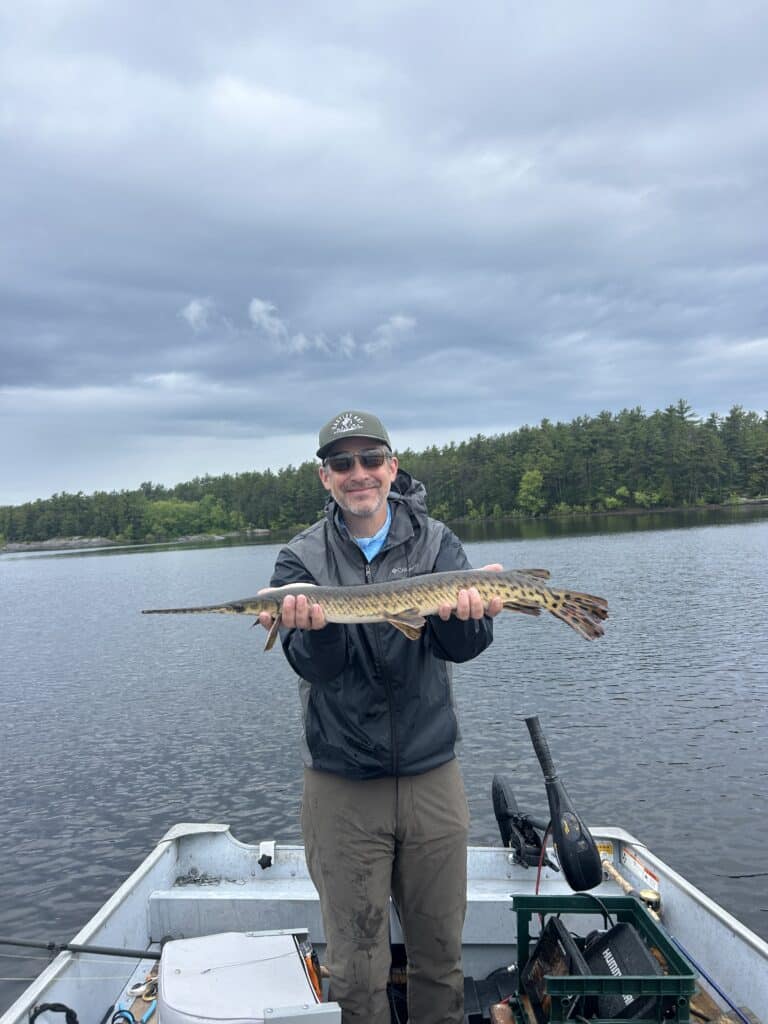
Whether you’re targeting Northern Pike with metallic spoons or testing your patience against the armoured jaw of a heavy Longnose Gar with a specialized rope rig, understanding these ancient rhythms makes every day on the water that much richer.
Ready to trace the currents of history yourself? Book your next trip to Bear’s Den Lodge, pack your gear, and come see what’s lurking in the historic waters of the French River.
Article by Joe Barefoot, M.B., Outdoor Writer and Nationally Published Author & Photographer. A member of the Professional Outdoor Media Association of Canada
Sources
Croft-White, M.V., Larocque, S.M., Reddick, D.T. et al. Diversity of movement patterns of Longnose Gar tracked in coastal waters of western Lake Ontario. Environmental Biology of Fishes (2023). https://doi.org/10.1007/s10641-023-01491-1
Burns, T. A., Stalling, D. T., & Goodger, W. (1981). Gar ichthyotoxin: its effect on crayfish, with notes on bluegill sunfish. Southwestern Naturalist, 25, 513-515.
Martin, H., & Akpunonu, P. (2020). Treating Ichthyotoxin Poisoning Induced by Gar Eggs Ingestion. International Journal of Medical Toxicology and Forensic Medicine, 10(3). https://doi.org/10.32598/ijmtfm.v10i3.31548
Netsch, N.F., & Witt, A. Jr. (1962). Contributions to the Life History of the Longnose Gar (Lepisosteus osseus) in Missouri. Transactions of the American Fisheries Society, 91(3), 251-262. https://doi.org/10.1577/1548-8659(1962)91[251:CTTLHO]2.0.CO;2
Pyzer, G. (quoting guide Rob Jackson). Northern Ontario’s Longnose Gar: One for the Bucket List. Northern Ontario Travel. https://northernontario.travel/fishing/northern-ontarios-longnose-gar-one-bucket-list