
At Bear’s Den Lodge, we are blessed to wake up every morning in the heart of the French River Delta—a landscape that has shaped, and been shaped by, the history of Ontario. For over a century, our family has called this wilderness home, watching loons glide across glass-still water at dawn and listening to the wind whisper through towering white pines. This province is more than just a destination for world-class fishing; it is a living tapestry of natural wonders and cultural legacies that unfold around every bend in the river.
As we celebrate our 101st year in the wild and look ahead to the 2026 season, we’ve put together this guide to the eight official symbols of Ontario. Whether you’re watching the sunset paint the sky from our screened-in veranda or navigating the rocky shorelines in search of your next trophy catch, you’ll see these symbols come to life all around you. They’re not just emblems on a government website—they’re the very fabric of the Ontario wilderness experience.
- The Coat of Arms: A Testament to Our Wildlife (Granted 1868, Updated 1909)

The symbolism runs deeper than simple representation. These three animals embody the spirit of Northern Ontario: the bear’s strength and resilience, the moose’s adaptation to harsh environments, and the deer’s grace through challenging terrain. When you spot these creatures during your stay, you’re witnessing living symbols of Ontario’s wild heritage.
The coat of arms also features the Cross of St. George above the shield, acknowledging Ontario’s British colonial heritage, while an elk and a moose serve as supporters on either side. It’s a design that has evolved over time, much like Ontario itself—rooted in history but always moving forward.
- Amethyst: Purple Treasure Beneath Our Feet (Official Mineral, 1975)

Ontario is home to the world’s largest deposits of amethyst, and this stunning purple quartz was rightfully recognized as the official mineral of Ontario in 1975. Found primarily in the Thunder Bay area and throughout Northern Ontario, amethyst represents the province’s incredible mineral wealth—a geological story written over billions of years.
At Bear’s Den Lodge, we have our own connection to Ontario’s remarkable geology. Our main lodge fireplace, the heart of countless evening gatherings, is built from locally sourced white quartz.

Look closely, and you’ll even spot flakes of gold embedded in the stone—a glittering reminder that you’re standing on some of the oldest rock formations in the world, part of the Canadian Shield that dates back over 2.5 billion years.
The French River area sits on this ancient foundation, where every rock tells a story of volcanic activity, glacial movement, and the slow, patient work of time. When you’re casting your line from a pink granite outcrop or exploring the shoreline, you’re touching geology that has witnessed the entire history of complex life on Earth.
- The Common Loon: The Voice of the Wilderness (Official Bird, 1994)
If there’s one sound that defines the Canadian wilderness, it’s the haunting, tremolo call of the common loon echoing across still water at dusk. This magnificent bird, with its distinctive black and white plumage and piercing red eyes, was officially recognized as Ontario’s provincial bird in 1994 through a bill introduced by former Sudbury MPP Sharon Murdock.

The French River is prime loon habitat, and our guests are treated to daily sightings of these remarkable birds. Loons are diving masters, capable of staying underwater for several minutes while hunting fish at depths of up to 200 feet. They’re also deeply territorial and mate for life, often returning to the same nesting sites year after year—much like many of our guests who return to Bear’s Den Lodge generation after generation.
Listen for the loon’s four distinct calls: the wail (a haunting contact call between mates), the tremolo (an alarm signal that sounds like maniacal laughter), the yodel (a territorial male call), and the hoot (a soft call between family members). Each tells a story about what’s happening in the loon’s world. There’s something profoundly moving about sitting on the dock as darkness falls, listening to loons call across the water—it’s a connection to wilderness that runs soul-deep.
- Eastern White Pine: Monarchs of the Forest (Official Tree, 1984)
Stand on our dock and look inland, and you’ll see the distinctive silhouettes of Eastern white pines piercing the skyline. These “Trees of Great Peace,” as they were known to the Haudenosaunee people, can reach heights of 80 feet or more and live for over 250 years. Designated as Ontario’s official tree in 1984, the white pine is deeply rooted in the province’s history.

These trees were once so valuable that the British Crown marked the tallest and straightest with the “King’s Broad Arrow” during colonial times, reserving them for ship masts for the Royal Navy. The white pine logging industry literally built Ontario, and the rivers—including the French River—served as highways for log drives that floated timber to sawmills and markets.
Today, these wind-swept pines serve as the backdrop for your morning boat rides and provide essential habitat for countless species. Their soft needles bundle in groups of five (an easy way to identify them), and their long, slender cones provide food for red squirrels, crossbills, and other wildlife. When the wind moves through their branches, it creates a distinctive sigh that old-timers say sounds like the forest breathing.
As you plan your 2026 wilderness getaway, imagine waking to the sight of these ancient sentinels standing guard over the river, their reflections perfectly mirrored in the morning calm. Learn more about the rich history of our area and why the French River has been a gathering place for over 6,000 years.
- White Trillium: Spring’s Delicate Herald (Official Flower, 1937)
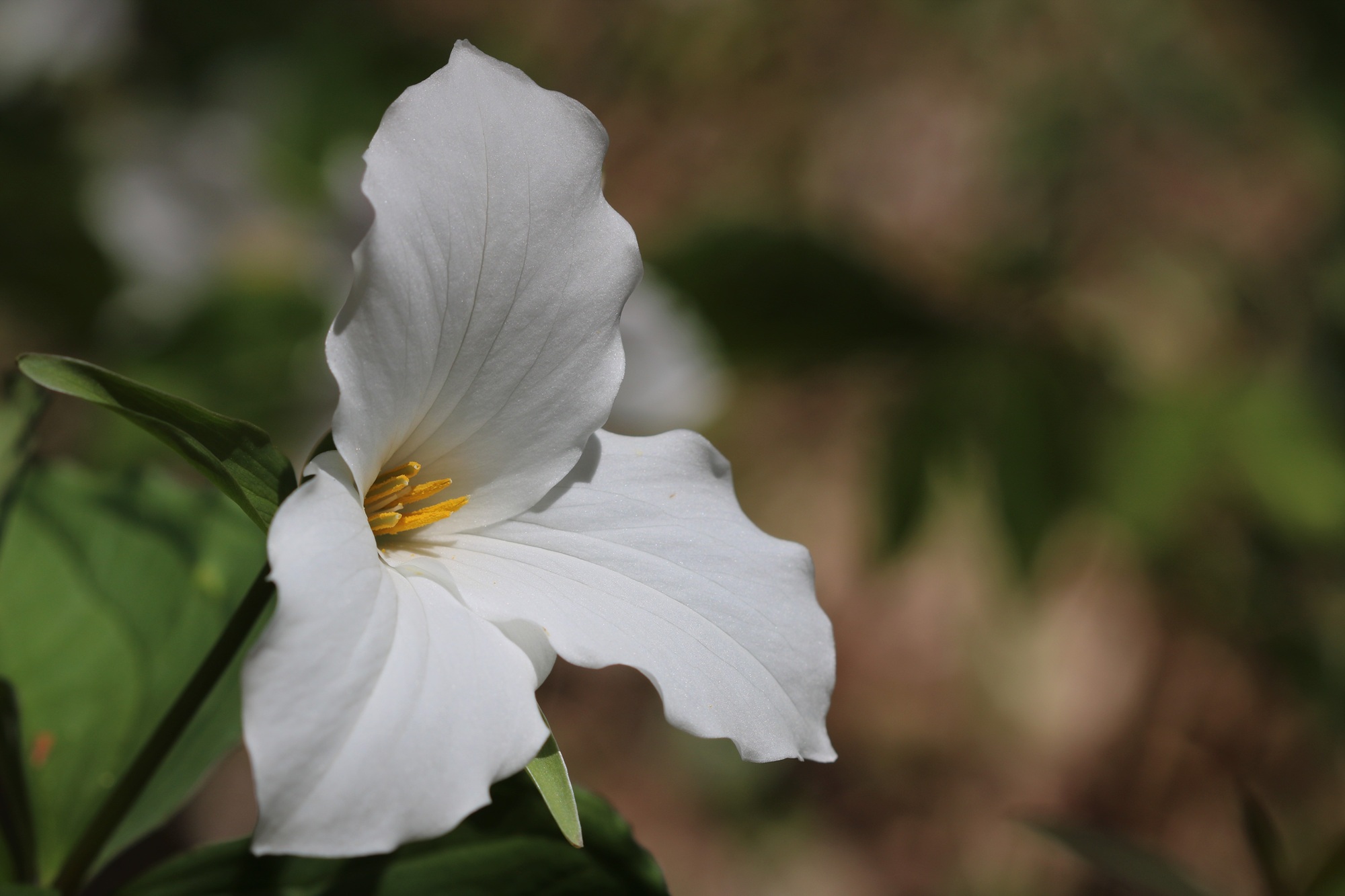
Each spring, the forests around Bear’s Den Lodge come alive with carpets of white trilliums. This three-petaled flower, Ontario’s official floral emblem since 1937, typically blooms in May—right around opening weekend for many fishing seasons. The trillium’s three-part symmetry (three petals, three sepals, three leaves) makes it instantly recognizable and has earned it the nickname “Trinity flower.”
White trilliums are remarkably long-lived plants. A single trillium can take 15-20 years from seed to first bloom, and mature plants can live for decades. This longevity comes with vulnerability—the plant stores all its energy in its underground rhizome, and picking the flower or damaging the leaves can severely set back or even kill the plant.
A note for our hiking guests: Please admire these beautiful flowers, but don’t pick them! It can take years for a trillium to recover from damage to its root system, if it recovers at all. Ontario law actually protects trilliums, and picking them on Crown land can result in a fine. Photograph them instead—their beauty is best enjoyed where they grow, and they’ll be there for future generations to discover.
The trillium is also culturally significant beyond its beauty. It blooms during the “Trillium Season,” that magical window in spring when the weather has warmed but the tree canopy hasn’t fully filled in, allowing sunlight to reach the forest floor. It’s a fleeting moment when the understory bursts with life—and a perfect time to explore the trails around the lodge.
- Ontario Tartan: Colours of the Province (Official Tartan, 2000)
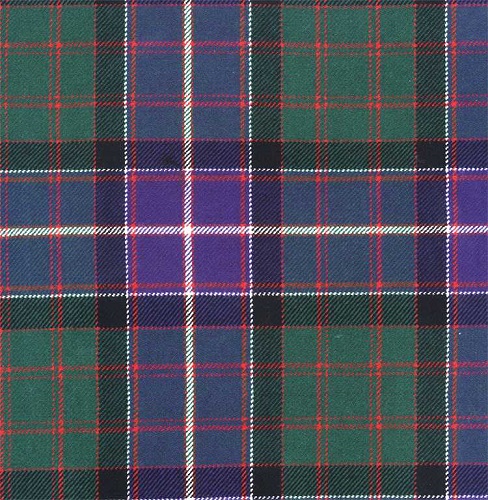
Adopted as Ontario’s official tartan in 2000, this distinctive pattern tells our story through colour. While you might not see many kilts on the fishing docks, the symbolism is beautiful and worth understanding:
- Red: Honours First Nations heritage and the Indigenous peoples who have called this land home for millennia
- White: Represents the vast Ontario sky—that endless canopy that stretches from horizon to horizon over the French River
- Green: Three shades capture our forests, fields, and the varied landscapes from southern farmland to northern boreal forest
- Blue: Two shades represent our endless waterways—from the Great Lakes to the thousands of rivers and lakes that define Northern Ontario
The tartan design was created by Rotarians from the Belleville area and officially recognized by the Legislative Assembly. It’s a modern symbol that acknowledges both Ontario’s natural beauty and cultural diversity—making it unique. Some of our staff even wear tartan accents during special events—a small but meaningful nod to provincial pride.
- Ontario Provincial Flag: Union and Heritage (Adopted 1965)

Ontario’s provincial flag, adopted in 1965, features the Union Jack in the upper left canton and the Shield of Arms of Ontario on the right side against a red field. This design symbolizes Ontario’s historical roots as a British colony and its steadfast loyalty to Canada.
The flag was adopted during a period when many provinces were establishing distinct provincial symbols. Its design purposefully balances heritage with provincial identity—the Union Jack acknowledges our British constitutional monarchy and parliamentary traditions, while the shield of arms is uniquely Ontarian, featuring that same bear, moose, and deer we mentioned earlier.
The Ontario flag flies proudly as a reminder that our wilderness retreat exists within a broader provincial and national story. The red field represents the sacrifice of Canadians in wartime, while the overall design connects us to the larger Commonwealth tradition.
- Franco-Ontarian Flag: A Bridge Between Cultures (Official Emblem, 2020)
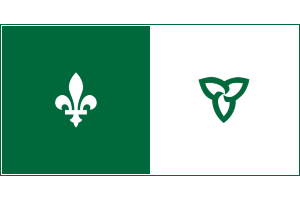
The newest addition to Ontario’s official symbols, the Franco-Ontarian flag, was recognized as an official emblem in 2020, though it has been proudly flown since 1975, when it was first raised at the University of Sudbury. This matters deeply in the French River area, where French heritage runs through the very name of the waterway.
The flag’s design is rich with meaning:
- Green: Represents Ontario’s summers and the lush landscape.
- White: Symbolizes our long winters and the snow that transforms the north.
- Fleur-de-lys: Honours the French-speaking community and their cultural heritage.
- White trillium: Creates a bridge between French and English Ontario, united by shared provincial symbols.
The French River has been a crossroads of cultures for centuries. French voyageurs paddled these waters during the fur trade era, and French-speaking communities have maintained a presence in Northern Ontario for over 400 years. At Bear’s Den Lodge, we’re proud to be part of this multicultural heritage—our location at the heart of the French River’s storied history means we’re literally surrounded by the legacy of French explorers, traders, and settlers who helped build Ontario.
The flag serves as a reminder that Ontario’s identity is not monolithic but rather a rich blend of cultures, languages, and traditions that strengthen our provincial character.
Experience Ontario’s Living Heritage in 2026
These eight symbols aren’t just items on a government list—they’re the living, breathing elements of the Ontario wilderness that surround you from the moment you arrive at Bear’s Den Lodge. The loons calling at sunset, the white pines standing sentinel along the shoreline, the trilliums carpeting the spring forest, and yes, even the occasional black bear ambling past the lodge—these are the experiences that connect you to something larger than yourself.
As we head into our 2026 season, we’re reminded that for 101 years, Bear’s Den Lodge has been a gateway to these authentic wilderness experiences. We’ve watched families grow over generations, seen countless sunrises paint the water gold, and heard thousands of loons calls echo across the French River Delta. This is Ontario at its finest—raw, beautiful, and utterly unforgettable.
Ready to experience Ontario’s symbols firsthand? Our 2026 season opens soon, and early bookings are filling fast. Whether you’re a returning guest or discovering the French River for the first time, there’s a piece of Ontario wilderness waiting for you at Bear’s Den Lodge. Contact us today to reserve your spot in this living heritage.
Joe Barefoot, M.B., Outdoor Writer and Nationally Published Author, Photographer, & Poet. A member of the Professional Outdoor Media Association of Canada.